





If you want to know what a scarf really is, turn it over and look at the edge. A hand rolled hem silk scarfcarries a small, even roll of fabric turned by hand and stitched with a nearly invisible thread, and that detail cannot be imitated convincingly by a machine that folds and sews in a straight line. The difference shows up when the scarf is knotted, when it is washed, and when it is held against light: a hand roll keeps its roundness through repeated wear, while a machine hem flattens into a hard crease. As a Scarves Factory, we have kept this operation manual even as we automated everything around it, and this article explains why the edge is still the dividing line between a premium silk scarf and a mass-market copy.
The work is slower than most buyers expect. A skilled operator rolls four to six millimeters of silk between the fingers, sets a stitch every one and a half millimeters, and works around all four sides without letting tension drift; a single ninety-centimeter square takes roughly twenty-five minutes, and a large one hundred ten-centimeter square closer to forty. That labour is the honest reason a hand-rolled scarf costs more, and it is the first thing cut when a supplier tries to compete on price alone. As a premium silk scarf manufacturer, we measure proficiency by consistency rather than speed: hem width is checked at twelve points per side, and any deviation beyond half a millimeter returns the piece to the operator. Our hand finished scarf factory trains new staff for six months before they work on client orders, because the first hundred hems a person sews are practice, not product.
Inspection is where the difference is proven or lost. Our silk scarf quality control protocol includes a light-table examination of both faces, a tension test along each hem, a corner inspection for puckering or twist, and a manual drape check to confirm the roll behaves evenly when the scarf is folded. Rejected pieces are logged by defect type, and a cluster of the same fault sends the batch back for re-hemming rather than out the door. For custom printed scarves, the hem also has to absorb a print allowance: we cut with eight millimeters of margin so the rolled edge never exposes raw white silk or a cut motif, and the artwork is adjusted before printing rather than after.
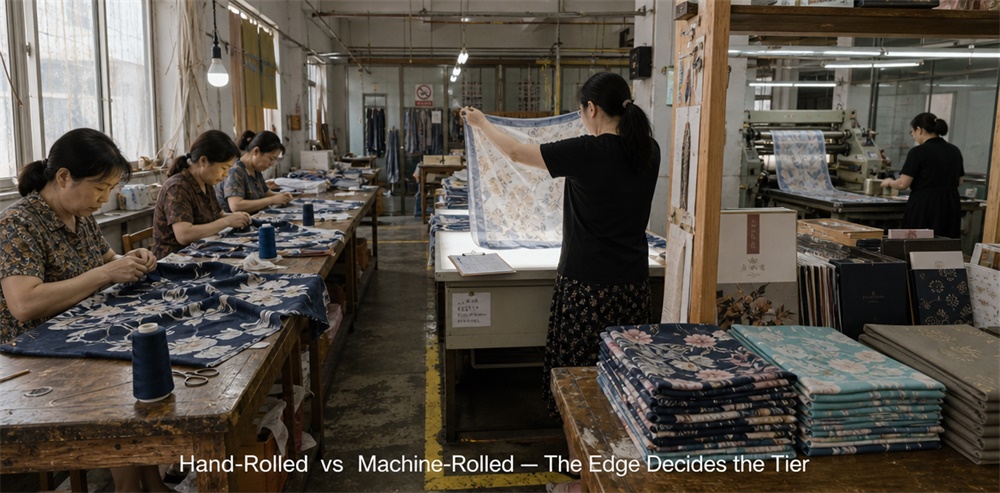
Market positioning follows from that process. As a silk scarf manufacturer China buyers can audit in person, we keep the hand-rolled line separate from machine-hemmed production, with different operators, different inspection criteria, and different pricing. Ourluxury scarf wholesale programmes are built on the hand-rolled standard, and we encourage buyers to compare a sample against whatever they currently stock: fold both, hold both to light, and look at how the corner sits. A buyer who can name the difference can also defend the price to their own customer.
Not every programme needs this. Our silk scarf for bank and enterprise staff lines are typically specified with machine-rolled hems and more durable finishing, because these scarves are worn daily and cleaned often, and a two-millimeter blind hem survives laundry better than a delicate hand roll. We also run a polyester scarf manufacturer division for volume gifting where silk is not the right answer on cost or care, and those hems are engineered for the same reason. Saying so plainly is part of the service; the wrong edge for the wrong programme is a return waiting to happen.
Post time: Oct-26-2026