





Two years ago, an eco friendly necktie was a specialty item that buyers ordered in small runs and priced as a statement piece. That has changed. In the collections we now produce, recycled yarns have moved from a niche add-on into the main body of the range, and the reason is practical rather than ideological: buyers ask for it, the documentation exists to support the claim, and the price gap has narrowed to the point where the decision is no longer a trade-off. Roughly a third of the corporate programmes we quote today specify recycled fibre, compared with almost none three years ago. As a Neckties Factory, we have reorganized our yarn sourcing and our quality checks around this shift, and this article explains what has actually changed on the production floor.
The technical core is the yarn. As a recycled polyester tie supplier, we work with post-consumer bottle flake converted into filament and spun yarn, certified through the Global Recycled Standard, with transaction certificates issued for each lot so the recycled content claim can be traced from bale to finished tie. Denier, tenacity, and crimp are specified per construction, because recycled filament does not behave identically to virgin polymer. A sustainable necktie manufacturer has to control hand-feel, not just the certificate: our spun recycled yarns are brushed and finished to reduce the plastic sheen that gave early recycled ties a poor reputation, and interlining weights are adjusted so the knot holds without feeling stiff. Every batch is tested for colour fastness, pilling, and dimensional stability before cutting, and the results are filed against the lot number.
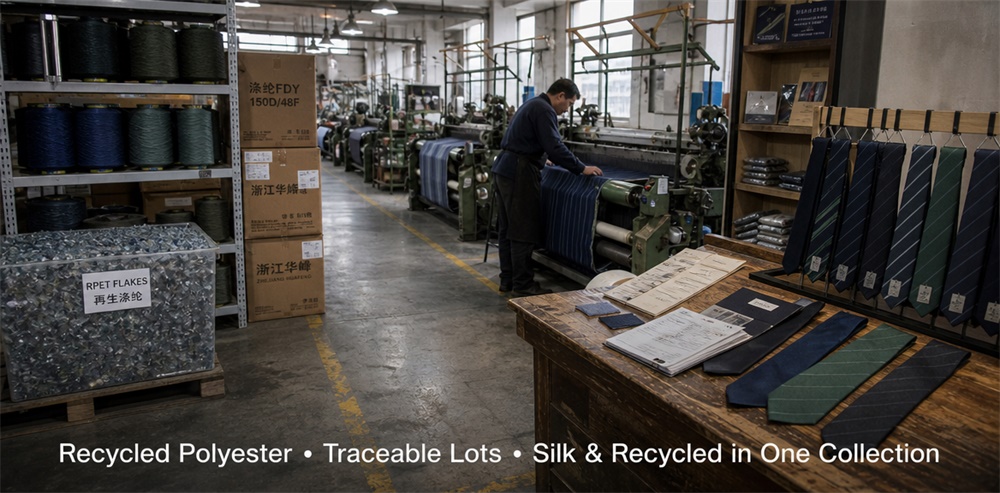
Scale is what makes this mainstream. At our eco tie factory Chinalines, recycled polyester now runs alongside silk and wool on the same jacquard and twill looms, which means a buyer can order a mixed collection without splitting it across suppliers. Forgreen corporate tie wholesaleprogrammes, we assemble documentation packs covering recycled content certificates, OEKO-TEX test reports, and care labelling, because procurement teams increasingly need evidence for sustainability reporting rather than a marketing phrase. Colour consistency across recycled lots is verified against Pantone references, since recycled feedstock can shift tone more than virgin polymer, and we hold approved references so a reorder placed after a season still matches.
Silk has not gone anywhere, and we would not pretend otherwise. Our wholesale silk ties remain the premium tier, and mulberry silk is a renewable fibre with strong biodegradability credentials, though its water footprint is higher than recycled polyester’s. The honest answer for most collections is a mix: silk for the retail ceiling, recycled polyester for volume. Wholesale Custom Ties programmes can now combine both fibres in one order, sharing a single pattern concept and identical colour references across price tiers, so a retailer can offer an accessible version and a premium version of the same stripe without running a second design process or a second supplier relationship.
Where this lands commercially is with institutional buyers. Necktie wholesale for corporate clients increasingly bundles uniform requirements with sustainability targets, and we support that with per-shipment reporting, fibre declarations, and consistent colour across repeat batches. Our custom striped necktie wholesale programmes are the workhorse of this category, since stripes adapt well to recycled yarns and remain the pattern most corporate buyers actually reorder. Request a sample in both fibres and judge the hand yourself; we will send the certificates with it.
Post time: Oct-20-2026