




Sourcing rules for silk accessories have tightened, and the questions arriving in our inbox have changed accordingly. Two years ago a buyer asked for a price and a lead time. Today the same buyer sends a questionnaire on certification, and the answers decide whether the order is placed. That shift is welcome, but it exposes a vocabulary problem: many buyers ask for the right documents while using the wrong names, and a supplier who nods along is not doing them a favour. As a Scarves Factory, we would rather explain what each certificate actually covers, including its limits.
Start with the one that causes the most confusion. Buyers frequently ask for a GRS certified silk scarf, and this is where the market gets murky: the Global Recycled Standard verifies recycled content and its chain of custody, so it applies to recycled polyester and nylon, not to mulberry silk, a virgin fibre that cannot be certified as recycled. What GRS does give you is a transaction certificate per batch of recycled yarn, plus social, environmental, and chemical criteria at the processing unit. For silk the relevant standards differ: GOTS for organic fibre content, the Organic Content Standard for blends, and facility-level programmes for processing. A sustainable silk scarf manufacturer should be able to name which certificate covers which claim, and decline the ones that do not apply.
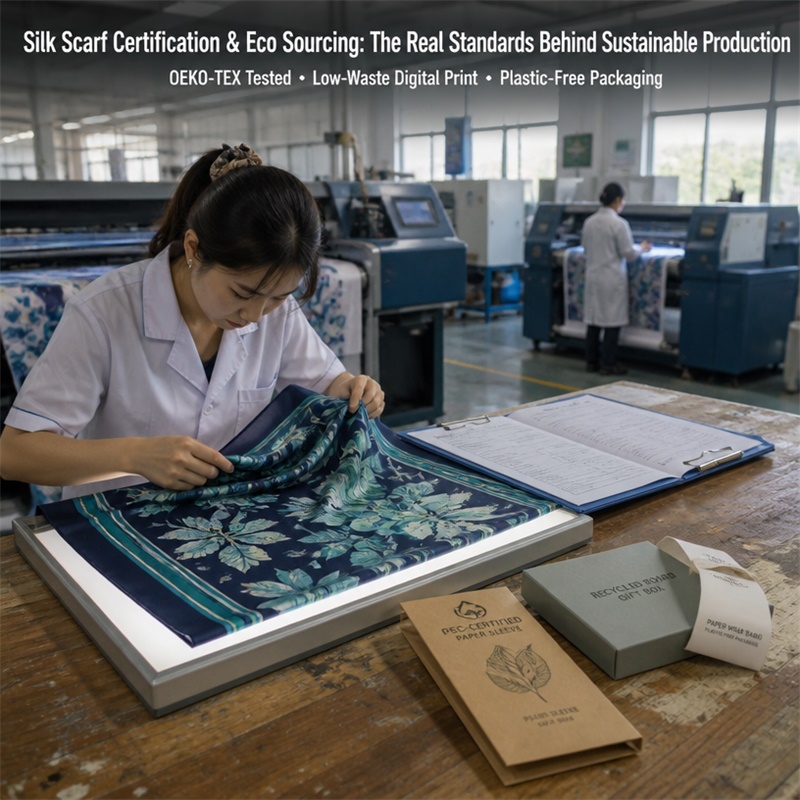
The second name buyers use most is OEKO-TEX. As an OEKO-TEX scarf supplier, we hold Standard 100 certification at product class II, the tier for articles worn close to the skin, which means the finished scarf is tested for harmful substances against published limit values, not a supplier’s own promise. The certificate is renewed annually and tied to a specific production site, which is why a copy from another factory is worthless. We also hold STeP certification at facility level for wet processing, covering chemical management, wastewater handling, and occupational safety. Any certified scarf factoryshould be able to show the product certificate number and its production site, and we encourage buyers to verify that number in the OEKO-TEX public directory.
Certification meets product in how the scarf is printed. Digital print silk scarf custom design work carries a genuine environmental advantage over screen printing for short and mid runs, and not for marketing reasons: no screen to wash out, no paste left over at the end of a run, and no minimum quantity forcing buyers to print more than they can sell. In our own production, paste waste is close to zero on a digital job and the wash water is treated and recirculated. For custom printed scarves, it also means a design can be tested in fifty pieces and scaled later, cutting dead stock.
The last piece is what buyers forget until the shipment is packed. For eco friendly scarf wholesale programmes, packaging often accounts for more waste than the scarf itself, so we offer recycled board boxes, FSC-certified paper sleeves, and plastic-free alternatives to the standard polybag, including paper bands and compostable film where the market accepts them. Custom scarf oem manufacturer clients can specify these per shipment, so a pilot run does not force a full packaging commitment.
For eco friendly packaging silk scarf orders, we prepare a documentation pack per shipment: certificate numbers, fibre content declarations, care labels, and packaging material specifications, so the buyer’s compliance team has one file to check instead of five. Ask which claims your product can honestly carry, and we will tell you plainly, including the ones we cannot support.
Post time: Nov-09-2026