





A retail buyer can tell more about a necktie from its reverse side than from its face. The label placement, the tip lining, the slip stitches along the fold, and the thickness of the interlining all reveal how much of the construction was done by hand and how much was rushed. Returns data says the same thing: ties that twist at the knot or lose their shape after a few wears come back to the store, and the cost of that return lands on the retailer. As a Necktie Factory, we build for that inspection, because tie wholesale is a business of repeatable standards rather than one impressive sample. This article walks through the construction stages that separate a tie that holds its shape after fifty wears from one that twists at the knot on the third.
Start with the fabric. Silk necktie craftsmanship begins with cutting on the bias, at forty-five degrees to the grain, which allows the blade to drape and knot without puckering. Our jacquard woven tie factory weaves face fabrics in two-by-two twill and one-by-one plain constructions, with the pattern registered so the motif sits correctly once the blade is cut and folded. Warp and weft density, yarn tension, and finishing calendar pressure are recorded per lot, and the same specification is repeated on the next order, which is what keeps a program consistent across seasons. We also keep a strike-off and a finished tie from each run, so a discussion about color or hand-feel refers to a physical reference rather than a memory.
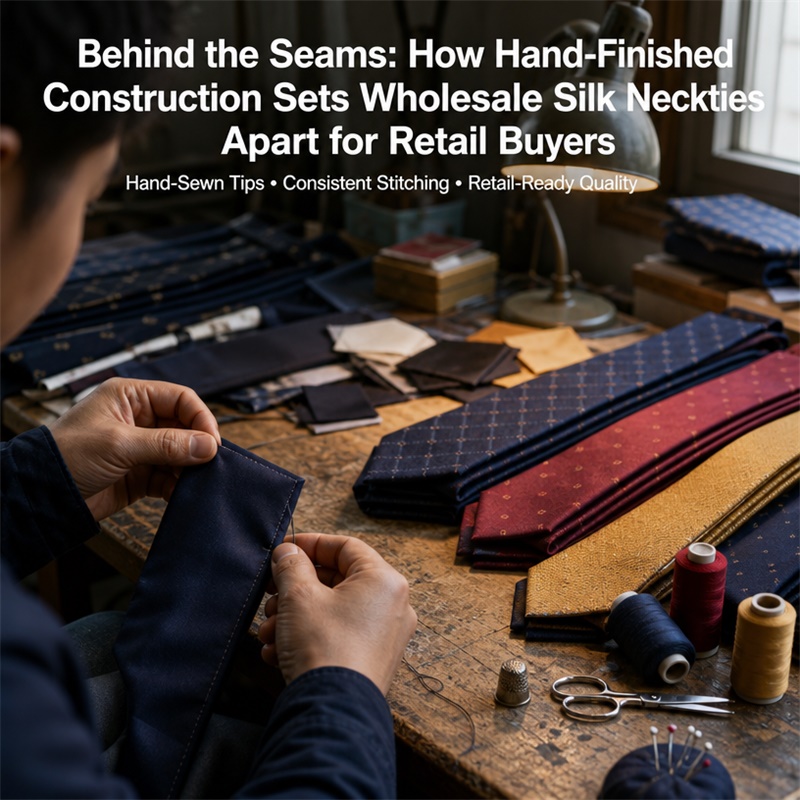
Construction is where the hand work lives. A handmade necktie supplier is expected to slip-stitch the seam and tack the ends by hand rather than by machine bar-tack alone, and that is the standard we hold on every silk program. As a premium tie manufacturer, we offer four-fold and seven-fold construction, wool interlining from three hundred to six hundred grams per square meter matched to the fabric weight, and hand-finished tipping at both ends. Between the fold and the lining, twenty-two hand stitches per inch tie the layers together while allowing the fabric to recover after knotting. Those stitches are invisible from the front, and they are the reason the tie does not pucker along the seam after pressing.
Inspection follows construction. Ourwholesale tie quality control protocol checks the blade for symmetry and length tolerance, verifies the interlining weight, confirms the keeper loop position, and inspects both tips for thread pull or puckering; the process ends with a shape test after pressing at retail hanging weight. Rejected pieces are logged with the reason, and a repeat fault triggers a review of the line settings rather than a simple rework. For buyers building a core range, custom classic necktie wholesale programs cover eight-centimeter blades at one hundred forty-eight centimeters, in solid, stripe, and houndstooth patterns, with woven labels and packaging under your own brand.
Not every program needs silk, and we say so plainly. Our Wholesale Polyester tie lines use high-twist spun polyester with a weighted interlining that resists shine and holds a knot through laundering, which suits uniform programs, hospitality groups, and promotional volume. As a cheap necktie bulk wholesalesupplier, we remove cost from trading layers and packaging choices, not from the construction steps listed above. Request a reverse-side sample, and judge the build for yourself; we keep approved references on file so the tenth shipment matches the first.
Post time: Sep-30-2026